What Is a Megawatt Worth?
Three Ways to Own a Megawatt
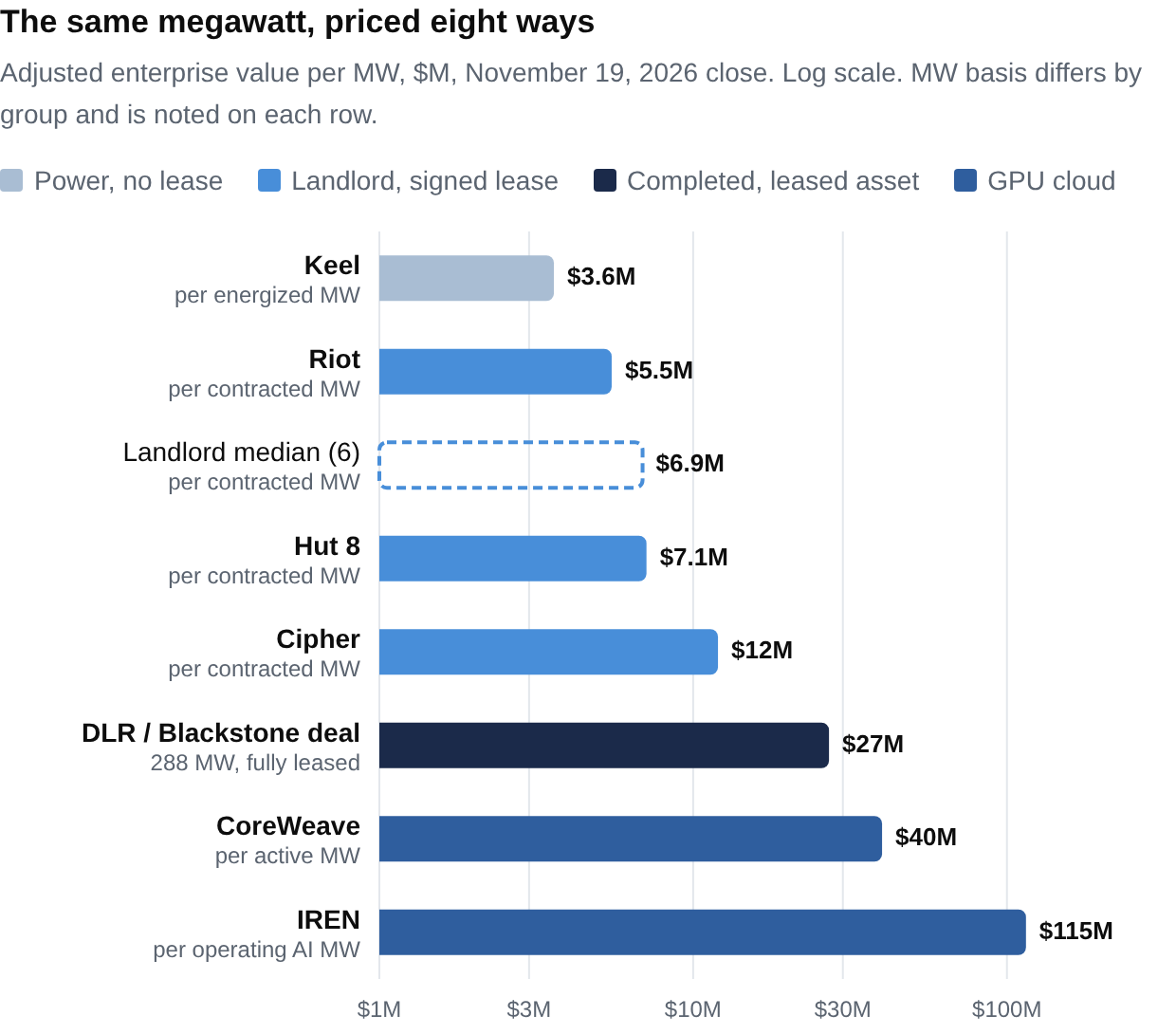
As of November, one megawatt (MW) of AI data center capacity was worth anywhere from ~$3.6M to ~$115M in the public markets, depending on what sits behind it. The grid connection is the same raw input in every case. What changes the price is whether a tenant has signed, whether the capital to build has been raised, and who owns the chips inside the building.
We sort the listed companies into three groups. Power holders control energized grid connections, many of them former bitcoin mining sites, but have not yet signed an AI tenant. Landlords have signed long-term leases and are building or financing the halls their tenants will occupy. GPU clouds own the chips and sell compute directly, earning far more revenue per MW while carrying the cost of every hardware generation.
Our conclusion is that the most attractive opportunity sits with AI landlords that have secured both a long-term tenant and the capital to deliver the building.
The Gap Between a Lease and a Constructed Building
The six listed landlords in our benchmark traded at a median of ~$6.9M of adjusted enterprise value per contracted MW, ranging from $5.5M at Riot to $12.0M at Cipher. A useful benchmark for what those assets can be worth at completion is Digital Realty's agreement to buy Blackstone's interest in three fully leased Northern Virginia facilities. The transaction valued 288 MW at $7.8B, or ~$27M per MW.
That leaves ~$20M per MW between where a contracted landlord trades and what a finished, leased building has fetched in a private transaction. Not all of it belongs to shareholders. On Hut 8's figures, construction alone runs $10M to $12M per MW, and the lenders funding it take their share. The investment question is how much of that gap equity holders can retain after paying for construction and financing.
The listed landlords also trade below what it costs a hyperscaler to put up the same building. JLL puts global shell-and-core construction at $11.3M per MW in 2026. Meta's announced budgets imply ~$10M per MW before chips: $10B for a 1,000 MW campus in Lebanon, Indiana, and ~$50B for more than 5 GW at Hyperion in Louisiana. At a median of ~$6.9M per contracted MW, the landlords are priced below the cost of replicating the building alone, and the signed lease and energized grid connection come with it. Construction costs are quoted per MW of IT capacity, so the comparison is approximate. If anything, replacement cost understates these sites, because no amount of capital makes a utility connect a new campus faster.
A Signed Lease Changes the Asset
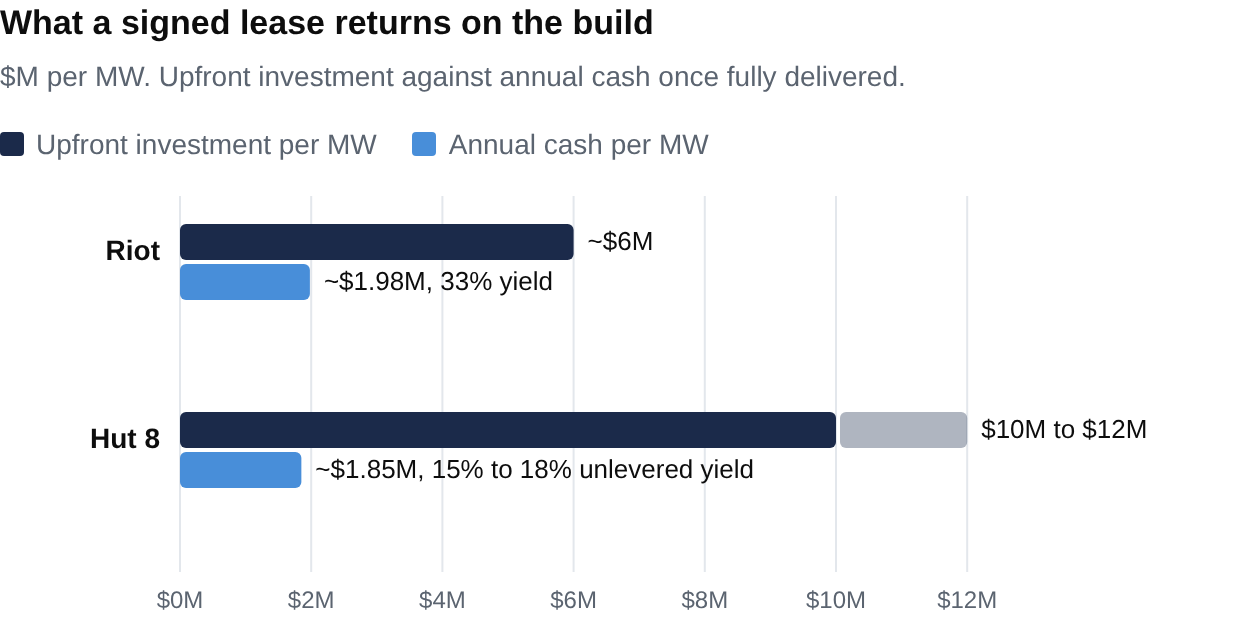
A signed lease can materially change what a power connection earns. Keel traded at ~$3.6M per energized MW while negotiating leases at three sites. Riot shows what signing can unlock. Its 15-year Corsicana lease commits a frontier AI lab to ~$1.8B in average annual rent for 910 MW, or ~$2.0M per MW each year. Riot expects to spend ~$6M per MW on site work and tenant reimbursements, implying a 33% yield on its investment once the campus is fully delivered.
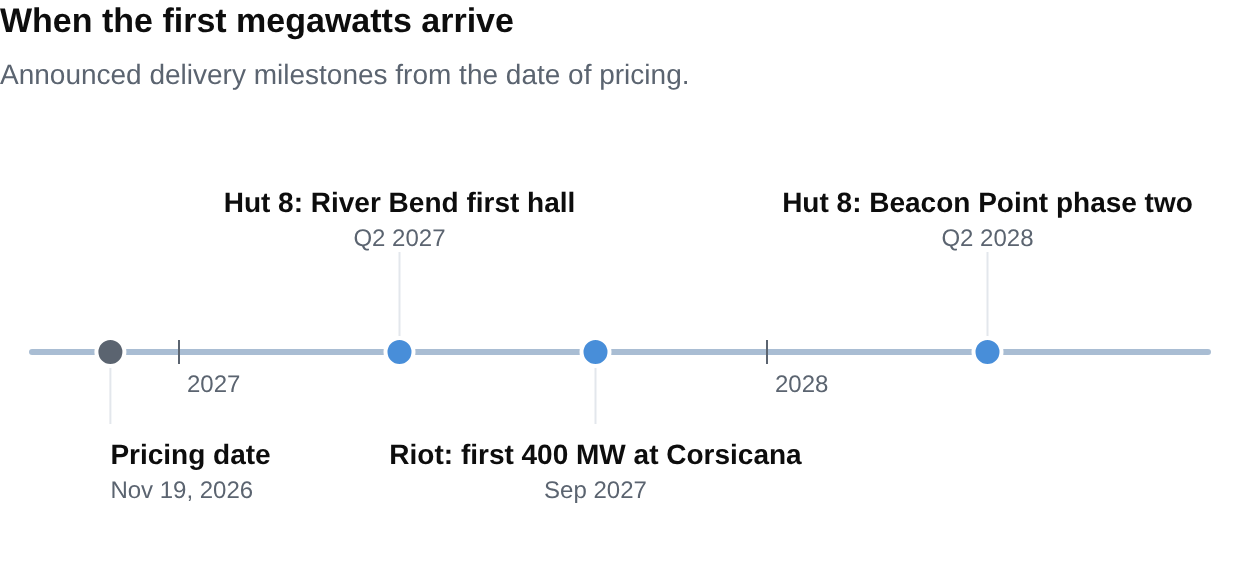
Riot shares rose 20% from November 5 to November 19, yet the company still traded at just $5.5M per signed MW across its portfolio. The first 400 MW at Corsicana are due in September 2027.
What Tenant Credit Is Worth
Hut 8 offers the clearest example of what tenant credit is worth to the equity. Its 949 contracted MW are expected to generate more than $1.75B of annual NOI at full delivery, or ~$1.85M per MW. Against a $10M to $12M construction cost, that implies a 15% to 18% unlevered yield.
Lenders have already priced that credit. Hut 8 financed the first phase of Beacon Point with $4.25B of non-recourse debt at a 6.13% coupon, leaving ~9 to 12 percentage points between the asset's unlevered yield and the cost of the debt that funds it. Even after the shares rose 21% from November 5, Hut 8 traded at ~$7.1M per signed MW. We would underwrite that spread against the delivery schedule. The first hall at River Bend is due in Q2 2027, and Beacon Point's second phase follows in Q2 2028.
Owning the Chips
Owning the GPUs produces more revenue per MW but leaves more capital dependent on the next contract. CoreWeave traded at ~$40M per active MW after reporting more than 1.7 GW in operation. IREN traded at ~$115M per operating AI MW despite a 20% share-price decline from early November, measured against the 93 MW it reported at quarter-end.
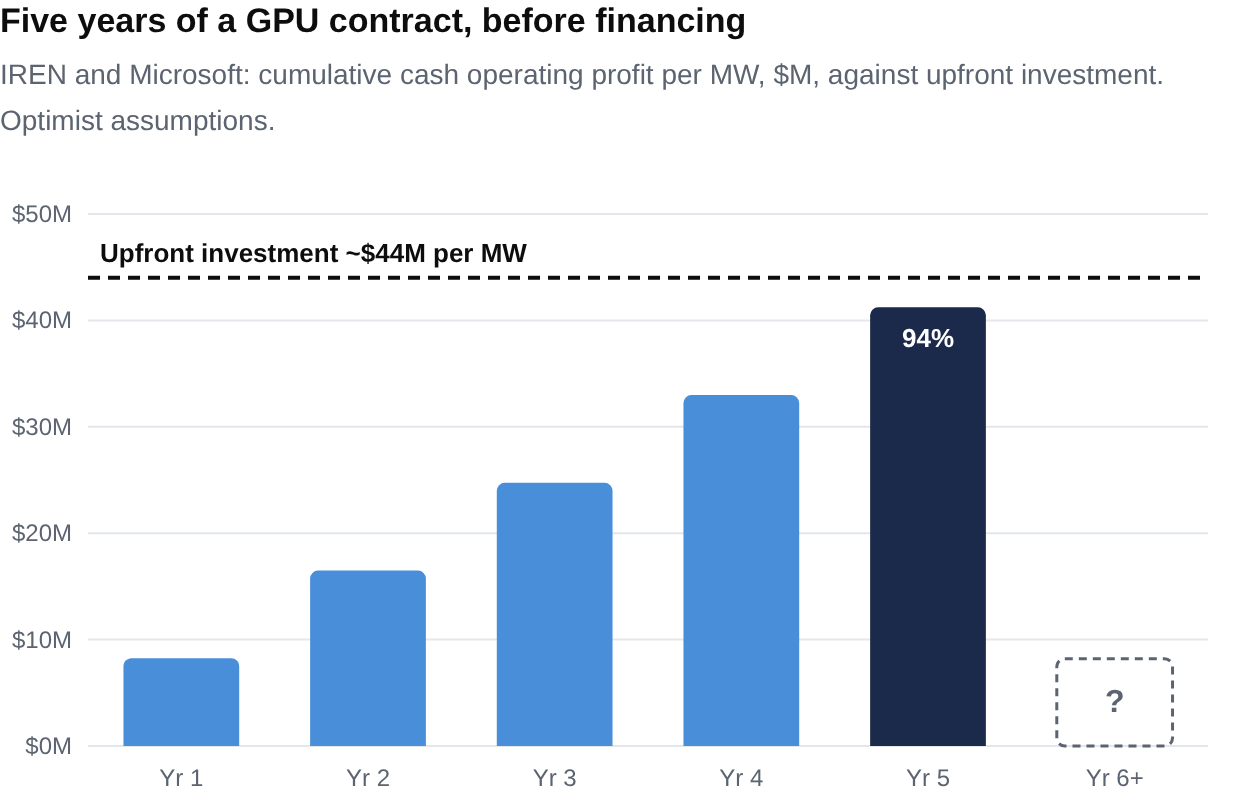
IREN's five-year Microsoft agreement illustrates the economics. At $9.7B across 200 MW, the contract generates ~$9.7M of annual revenue per MW. On our assumptions of $44M in upfront investment per MW and an 85% cash operating margin, the initial term recovers ~94% of that investment before financing. The return then depends on what the chips and the building can earn in year six.
What We Would Underwrite
Every landlord thesis above is a bet on delivery. The leases are signed and the financing is in place for the first phases, but the cash arrives only as halls are handed over.
We would ask four questions of any listed or private AI landlord:
Is the tenant signed, and for how long? Fifteen to 20 years of rent is a different asset from a five-year compute contract.
Is the construction capital committed, and does its cost leave a spread to the asset's unlevered yield?
When does the first hall deliver, and what does the equity hold until then?
Who pays for the next GPU generation?
We favor the landlord that can secure 15 to 20 years of rent while its tenant bears the cost of the next GPU generation. Public markets still price those leases at roughly a quarter of what a finished, leased building has sold for. The discount is an opportunity, and delivery is the execution risk.
Valuations use November 19, 2026 closing prices. Landlord estimates retain reported balance-sheet adjustments, including restricted cash and bitcoin at carrying value. GPU valuations use the latest reported operating capacity. This post is for informational purposes only and is not investment advice.